
Note: Examples provided in this blog post use ChatGPT 3.5
Introduction
When many educators think about AI in English Language Arts, their first thoughts often center on concerns such as students relying on AI to complete assignments, losing opportunities to develop critical thinking skills, or finding new ways to design lessons that are less vulnerable to AI-generated work.
However, AI in English Language Arts can be much more than a challenge to manage. When used intentionally, it can transform the way students learn, streamline lesson preparation, and even strengthen writing instruction by providing meaningful support throughout the writing process.
While working as a reading interventionist during the 2023-2024 school year, I incorporated generative AI platforms such as ChatGPT, Gemini, and Claude into my daily instruction to maximize the intervention support my students received. The time savings were remarkable, but the biggest benefit was the impact on student learning.
As I discovered new ways to use AI in English Language Arts, my students made measurable progress, and I had the opportunity to share practical strategies with my high school’s English Language Arts teachers. Rather than viewing AI as something to fear, we explored how it could become a valuable instructional tool when paired with thoughtful teaching practices.
The following are three practical ways teachers can implement AI in English Language Arts classrooms to support instruction, save time, and enhance student learning.
Learn the basics of prompt engineering
One of the first things I emphasized to teachers exploring AI in English Language Arts was the importance of learning prompt engineering. Whichever generative AI platform you use, the quality of your results depends heavily on the quality of your prompt.
According to AWS, prompt engineering is the practice of crafting specific text instructions to guide and enable generative AI to produce high-quality, relevant outputs. While developing effective prompts often involves some trial and error, understanding a few key principles can make the process much easier.
To summarize IBM’s “Tips for writing foundation model prompts“, a strong prompt includes one or more of the following:
- Instruction
- Context
- Examples
- Cue
Learning these components is one of the most valuable skills teachers can develop when implementing AI in English Language Arts because they consistently lead to more accurate, useful, and classroom-ready responses.
Let’s put this into practice by providing an example using ChatGPT (although you are more than welcome to use the GenAI platform of your choice).
Imagine you’re a 10th-grade English Language Arts teacher who wants to create sentence stems for English Language Learners (ELLs) to use during journal writing. After reviewing your students’ language proficiency data and recent writing samples, you know they have a basic understanding of English and can write about familiar topics, but they often struggle to respond thoughtfully to literature.
Instead of asking for sentence stems with a short, generic request, you provide ChatGPT with meaningful context:
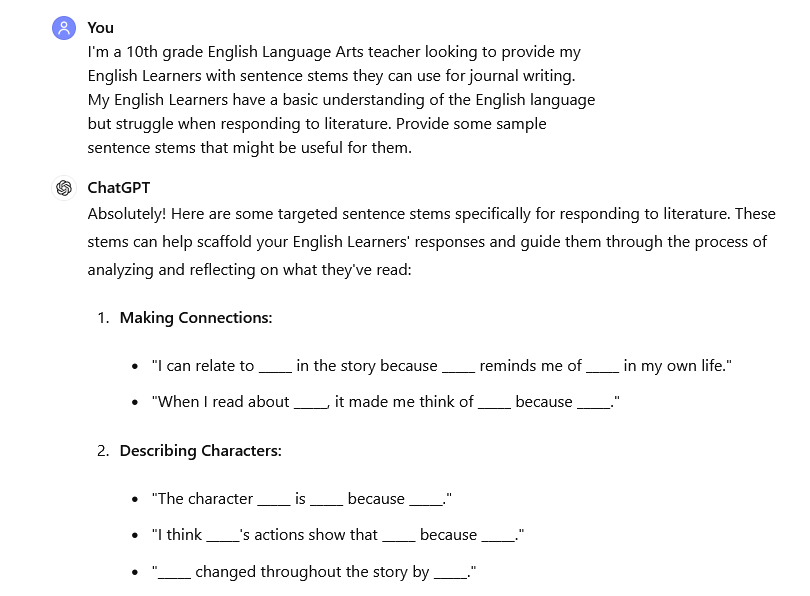
I’m a 10th grade English Language Arts teacher looking to provide my ELLs with sentence stems they can use for journal writing. My ELLs have a basic understanding of the English language but struggle when responding to literature. Provide some sample sentence stems that might be useful for them.
Now, we prompt ChatGPT with this request, and it provides us with the following:
Now, you might be wondering what would happen if no context was provided in our prompt and we opted for something simpler. Let’s assume that we use the following prompt instead:
Provide some sample sentence stems that might be useful for ELLs responding to literature.
Prompting ChatGPT with this request, we get the following:
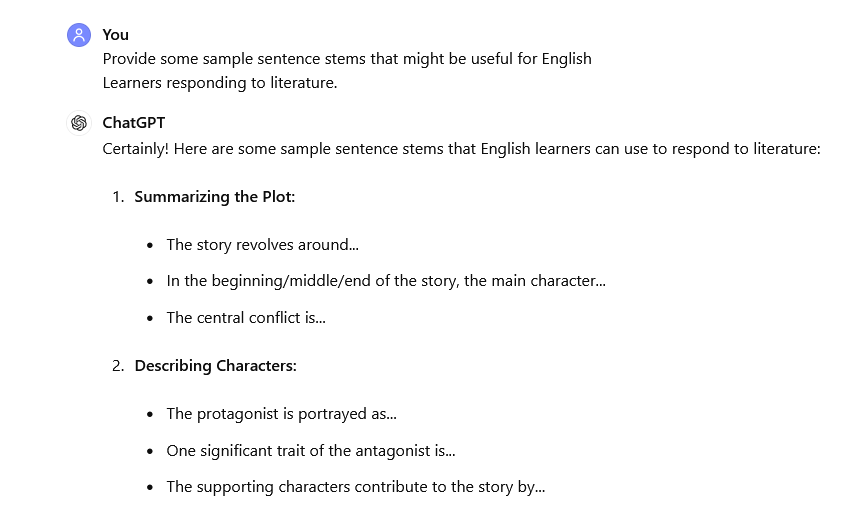
See the difference?
The difference in the responses is often significant: by giving the AI additional context about your students and instructional goals, you’re far more likely to receive responses that are tailored to your classroom needs.
This is one of the biggest advantages of using AI in English Language Arts. Well-crafted prompts can save teachers time while generating instructional materials that require fewer revisions before they are classroom-ready.
It’s important to remember that even with strong prompts, always review every AI-generated response carefully. Generative AI can still hallucinate—produce information that’s inaccurate or entirely made up—so teachers should always verify that the content is appropriate, factual, and aligned with their instructional goals before sharing it with students.
Practice using AI to analyze literature
Once you’ve learned the basics of prompt engineering, the next step in implementing AI in English Language Arts is simply practicing with it. One of the best ways to build confidence is by asking generative AI to analyze literature you already teach.
Using AI in English Language Arts for literary analysis gives you new ways to help students make sense of challenging texts, generate discussion questions, identify literary devices, or develop fresh, instructional ideas. The more you experiment with AI, the better you’ll understand both its strengths and limitations.
For this example, we’ll use ChatGPT to analyze Pablo Neruda’s “Tonight I Can Write”.
There are two ways we can do this:
- We can flat out ask ChatGPT to analyze the poem (this might create hallucinations).
- We can copy/paste the poem into ChatGPT and ask it to analyze the poem (this guarantees a little more accuracy).
Let’s compare both approaches.
First, I prompted ChatGPT to analyze the poem without including context.
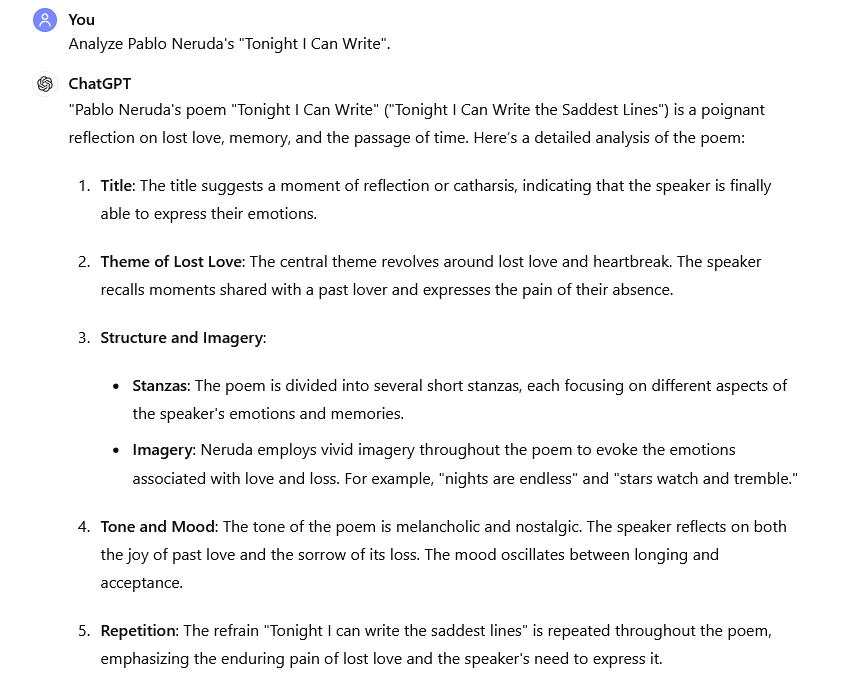
Although the overall analysis was useful, it immediately revealed an example of a hallucination. In the imagery section, ChatGPT referenced the phrases “nights are endless” and “stars watch and tremble”. However, the phrase “stars watch and tremble” doesn’t actually appear anywhere in the poem.
That error aside, much of the literary analysis was thoughtful and relevant. But what happens when I provide the poem first and then ask ChatGPT to analyze it?
See for yourself:
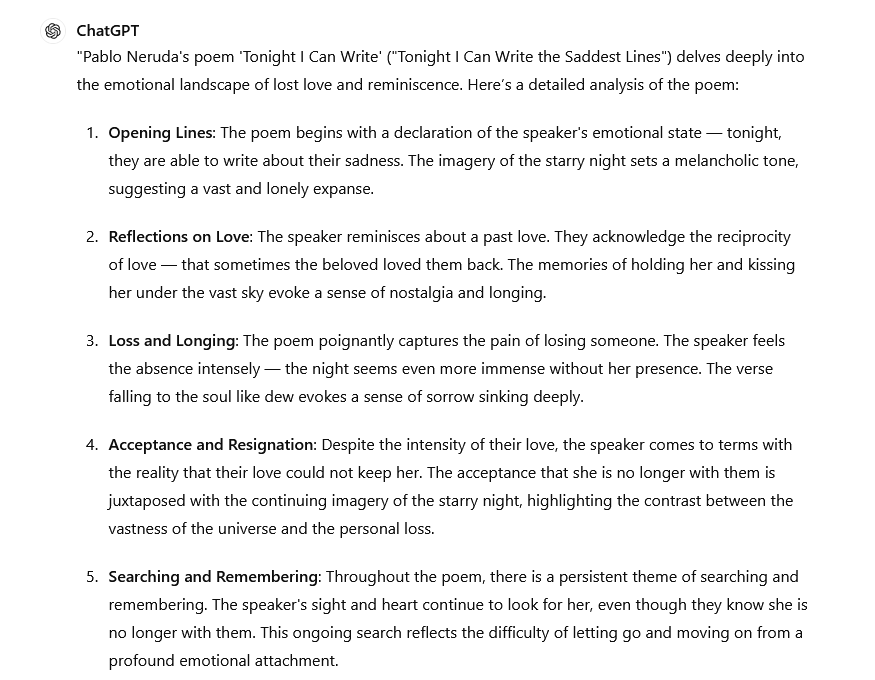
The results were very similar; however, the analysis stayed grounded in the actual text, and I found no obvious hallucinations.
Experiments like this demonstrate an important lesson about using AI in English Language Arts effectively: the quality of the AI’s output often depends on the quality and completeness of the information you provide. Supplying the original text (if possible) gives the model a stronger foundation for producing accurate analyses.
Whether you’re generating literary analyses, discussion questions, or writing activities, always review AI-generated content before using it with students. Careful fact-checking helps ensure your lessons remain accurate, rigorous, and aligned with your instructional goals.
Use AI to help students analyze or understand literature
After you’ve developed confidence in evaluating AI-generated literary analysis, the next step in implementing AI in English Language Arts is using it to create instructional supports that help students engage more deeply with complex texts.
One of my favorite applications of AI in English Language Arts is designing scaffolds for students who need additional support. Rather than replacing close reading, AI can help teachers create questions, sentence stems, vocabulary supports, and discussion prompts that make rigorous texts more accessible.
Let’s return to our example of 10th-grade ELLs who have a basic understanding of English but struggle to analyze literature. Instead of creating every question from scratch, you can ask ChatGPT (or your preferred platform) to generate close-reading questions for Pablo Neruda’s “Tonight I Can Write”.
For example, you might use the following prompt:
I’m a 10th grade English Language Arts teacher looking to provide my ELLs some close-reading questions for poetry. The poem they are about to read is “Tonight I Can Write” by Pablo Neruda; my ELLs have a basic understanding of English, so they struggle to analyze or understand poetry. Provide me with some close-reading questions they can answer as they’re reading the poem.
Here’s what ChatGPT generated
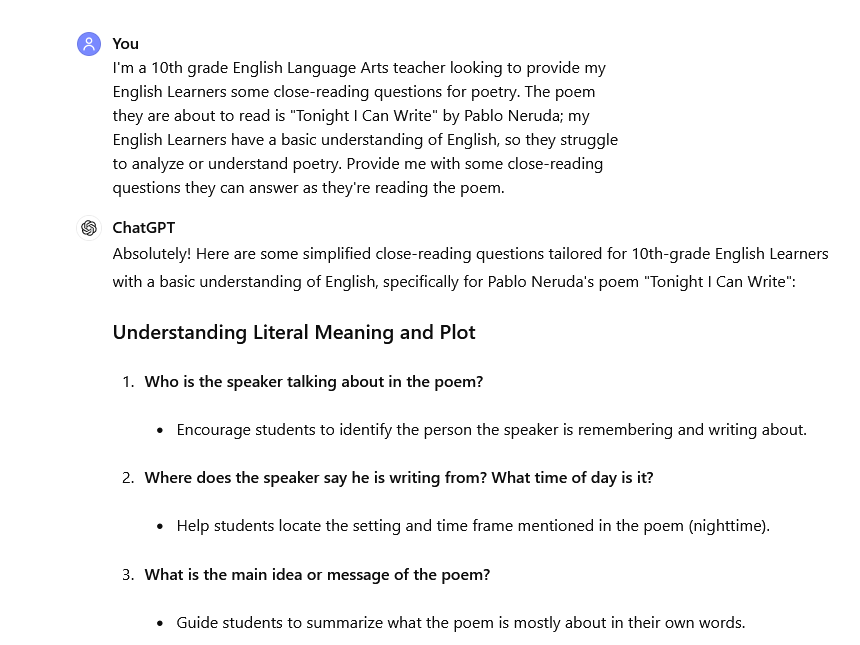
Note: The response was longer, but I had to make the screenshot smaller to save space.
The questions were a solid starting point and required only minor revisions before they were ready for classroom use. Rather than treating AI’s output as a finished product, I viewed it as a draft that I could refine to better match my students’ needs and instructional objectives.
This approach highlights one of the greatest strengths of AI in English Language Arts. Instead of spending valuable planning time creating every scaffold from the ground up, teachers can use AI to generate initial ideas, then apply their professional expertise to adapt those materials for their specific students.
And close-reading questions are only the beginning. The same prompt engineering strategies can be used to generate vocabulary activities, discussion prompts, writing organizers, alternative assignments, formative assessments, and other instructional resources that support student learning while reducing lesson preparation.
Conclusion
After sharing these strategies with the English teachers I worked alongside, many walked away with a clearer understanding of how to implement AI in English Language Arts thoughtfully and responsibly. More importantly, they saw how AI could become a practical teaching assistant, one that helps generate instructional materials, improve learning outcomes, and reduce planning time without replacing the expertise of the teacher.
As you begin or continue exploring AI in English Language Arts, remember that every AI-generated response should be reviewed for accuracy. Generative AI can still hallucinate or misinterpret a text, so your professional judgment remains the most important part of the process. AI is most effective when it serves as a tool to support great teaching, not substitute for it.
How are you using AI in English Language Arts? Have you discovered a prompt, strategy, or classroom activity that has saved you time or improved student learning? Share your experiences in the comments below—I’d love to hear your ideas.




Leave a Comment